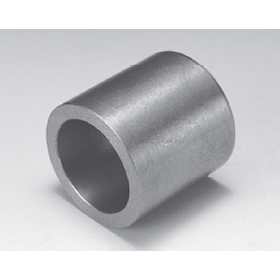
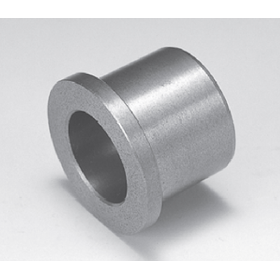
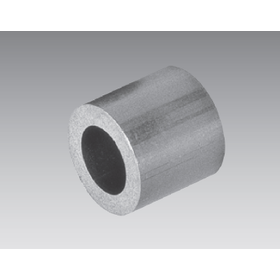
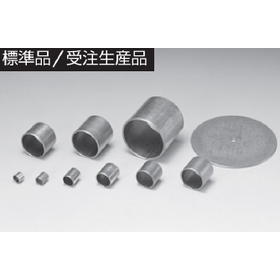
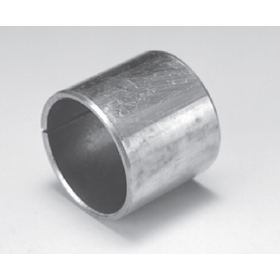
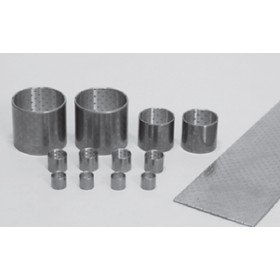
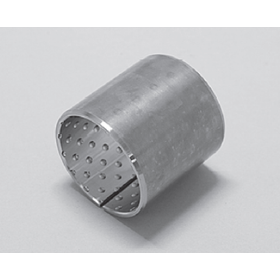
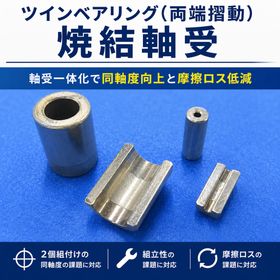
Addressing the issues of coaxiality, assembly, and friction loss in a twin bearing sintered bearing with a two-piece assembly.
When two bearings are arranged with shaft support, challenges arise such as "difficulty in ensuring coaxiality during assembly" and "the desire to reduce the number of parts." On the other hand, long straight bearings can increase the contact area of the inner diameter, leading to greater friction loss.
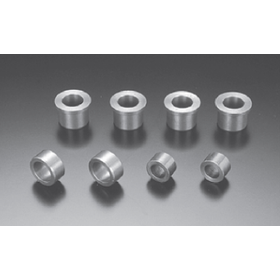
DIA-MET's twin bearing integrates the bearing functions that were traditionally supported by two separate units. By making both ends sliding parts and the central part a relief shape, it maintains the shaft holding length while minimizing the contact area.
■ Integration of two bearings
▼ Improved inner diameter coaxial accuracy through integrated manufacturing
▼ Easier assembly compared to using two separate units
▼ Maintains contact area during assembly with an outer diameter straight shape
■ Reduced friction loss
▼ The central part is designed as a relief shape, reducing the inner diameter contact area
▼ The sliding parts at both ends ensure the shaft holding length
▼ Good pore condition is maintained on the sliding surface
■ Compatibility with small diameters
▼ Can be manufactured with inner diameters from approximately φ10 to φ1.5
The integration of bearings allows for a comprehensive review of the number of parts, assembly efficiency, coaxiality, and friction loss, making it useful for designs that aim to address these aspects.
Documents summarizing the structure, inner diameter shape, and comparisons with conventional products of the twin bearing, as well as more detailed benefits of improved assembly efficiency and reduced friction loss due to bearing integration, can be downloaded below.